Bi-monthly news update from IsDB-BISEW IT Scholarship Programme (July 202)
Jul 20, 2026 / IT Scholarship Programme
Empower

Welcome to the July 2026 issue of Empower, the periodic newsletter of the IsDB-BISEW IT Scholarship Programme. This edition features the following topics of note:
-
Antrhopic AI Tools, Products & Capabilities: A 2026 Overview
-
Placement Status January ‘26-May ‘26 – IT Scholarship Programme
Anthropic AI Tools, Products &
Capabilities: A 2026 Overview
From Claude Haiku to Claude Fable 5 — the full landscape of Anthropic's AI ecosystem
1. Introduction
Anthropic is a public benefit AI safety company founded in 2021 by former members of OpenAI, including CEO Dario Amodei and President Daniela Amodei. Its mission is to develop AI systems that are safe, beneficial, and understandable. The company's principal product is the Claude family of large language models (LLMs), which has grown from a single conversational assistant into a layered ecosystem of models, developer tools, agentic platforms, and productivity integrations.
As of mid-2026, Anthropic has reached a revenue run rate of approximately $47 billion, closed a Series H funding round at a $965 billion valuation, and filed its IPO prospectus with the SEC. Commercially, Claude models are available directly to consumers and professionals via Claude.ai, to developers via the Claude API, and on major cloud platforms including Amazon Web Services (Bedrock), Google Cloud (Vertex AI), and Microsoft Foundry. This article surveys the full product landscape, from the underlying models to the developer infrastructure and emerging agentic tools — with a focus on the latest commercially available releases.
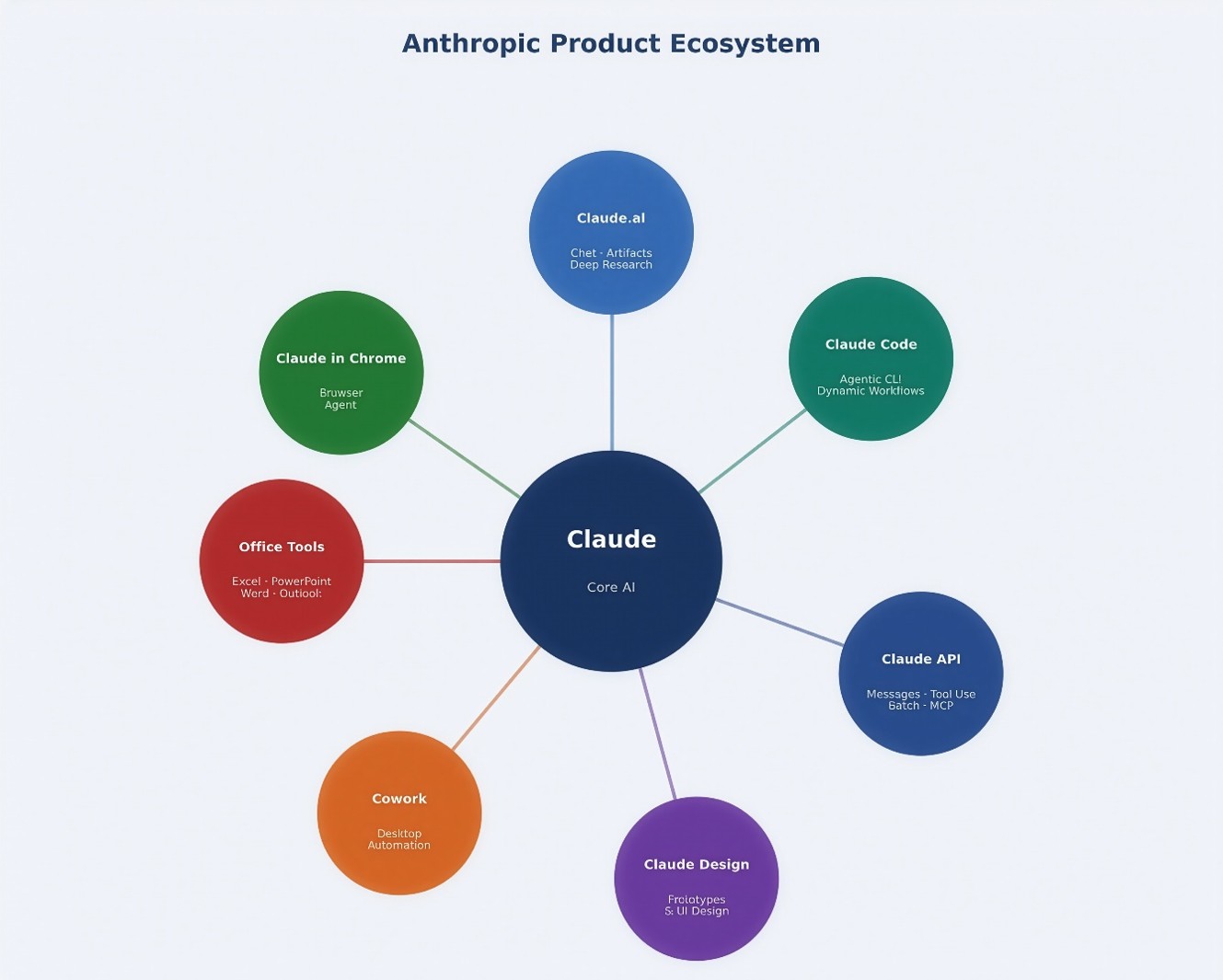
Figure 1: The Anthropic product ecosystem — Claude models at the centre, surrounded by the major commercial and developer surfaces.
2. The Claude Model Family
Anthropic organises its models into tiers that represent different trade-offs between capability, speed, and cost. As of June 2026, four tiers exist: Haiku, Sonnet, Opus, and the newly introduced Mythos class, currently represented by Claude Fable 5 for general commercial use.
2.1 Claude Haiku — Speed and Efficiency
Claude Haiku 4.5 (released October 2025) is Anthropic's fastest and most cost-efficient model. It is designed for high-volume, latency-sensitive workloads such as content classification, real-time customer support routing, automated tagging, and lightweight question-answering pipelines. Its low cost per token makes it attractive for applications that need to handle thousands of requests per minute without sacrificing basic language understanding.
2.2 Claude Sonnet — Balance and Versatility
Claude Sonnet 4.6 (released February 2026) occupies the middle tier, delivering strong performance at moderate cost. It is the default model powering Claude.ai for most everyday tasks and is widely used in production environments where developers need near-Opus quality without Opus pricing. Sonnet 4.6 supports coding, document analysis, long-context reasoning, and agent workflows, and was among the first Claude models to support a one-million-token context window.
2.3 Claude Opus — The Flagship Workhorse
Claude Opus 4.8, released on 28 May 2026, is Anthropic's most capable mainstream flagship model. It builds on Opus 4.7 with significant gains across agentic coding (SWE-Bench Pro: 69.2%), computer use (OSWorld-Verified: 83.4%), and multidisciplinary reasoning. A 1-million-token context window and up to 128,000 output tokens are supported by default on the Claude API, Amazon Bedrock, and Google Vertex AI.
Key features introduced with Opus 4.8 include adaptive thinking — where the model automatically adjusts how much reasoning it applies based on task complexity — and user-selectable effort controls (high, xhigh, and max) available in Claude.ai and Cowork. A fast mode, available in research preview on the API, runs at 2.5× the speed of standard mode and is three times cheaper than fast mode on prior Opus versions. Anthropic also reports that Opus 4.8 is approximately four times less likely than its predecessor to let coding flaws pass without comment — a meaningful alignment improvement for software engineering applications. Pricing remains $5 per million input tokens and $25 per million output tokens, with up to 90% savings via prompt caching.
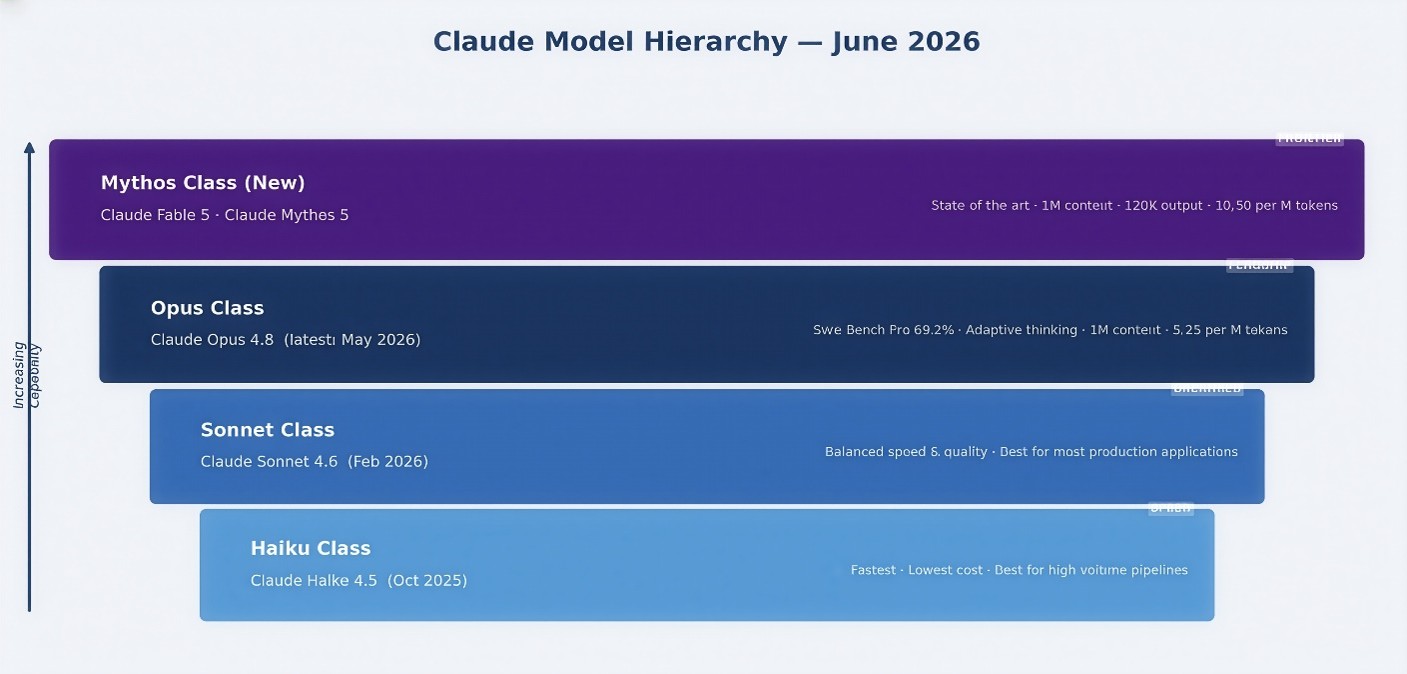
Figure 2: The Claude model hierarchy as of June 2026, showing the four tiers from Haiku through to the new Mythos class.
2.4 Claude Fable 5 & Claude Mythos 5 — A New Frontier
On 9 June 2026, Anthropic launched Claude Fable 5 and Claude Mythos 5, introducing an entirely new capability tier that sits above the Opus class. The two models share the same underlying weights; the distinction is one of safeguards. Fable 5 is the general-availability release, equipped with safety classifiers that automatically route high-risk queries (notably in cybersecurity and biology) to Claude Opus 4.8. Mythos 5 has some of those classifiers lifted and is available exclusively to approved participants in Project Glasswing — Anthropic's trusted cybersecurity program, which includes partners such as JPMorganChase and Google.
Claude Fable 5 represents a step-change in capability. On SWE-Bench Pro (agentic coding), it scores 80.3% — an eleven-point improvement over Opus 4.8. On spatial reasoning it scores 38.6%, nearly triple Opus 4.8's 14.5%. Legal reasoning reached 13.3%, compared to GPT-5.5's 2.1% and Gemini's 0.0%. In early testing, Stripe reported that Fable 5 performed a codebase-wide migration across 50 million lines of Ruby code in a single day — work the team estimated at over two months for a full engineering team. The model supports a 1-million-token context window with up to 128,000 output tokens, and is priced at $10 per million input tokens and $50 per million output tokens.
3. Benchmark Performance
The chart below summarises performance on key third-party benchmarks comparing Claude Fable 5, Claude Opus 4.8, and OpenAI's GPT-5.5. Fable 5 leads on four of the five benchmarks tested. GPT-5.5 holds a narrow lead on Terminal-Bench 2.1, a benchmark focused on terminal-based coding tasks. These benchmark results, published by Anthropic at the time of the Fable 5 launch, have been corroborated by independent testers including Cursor, GitHub, and CoCounsel Legal.
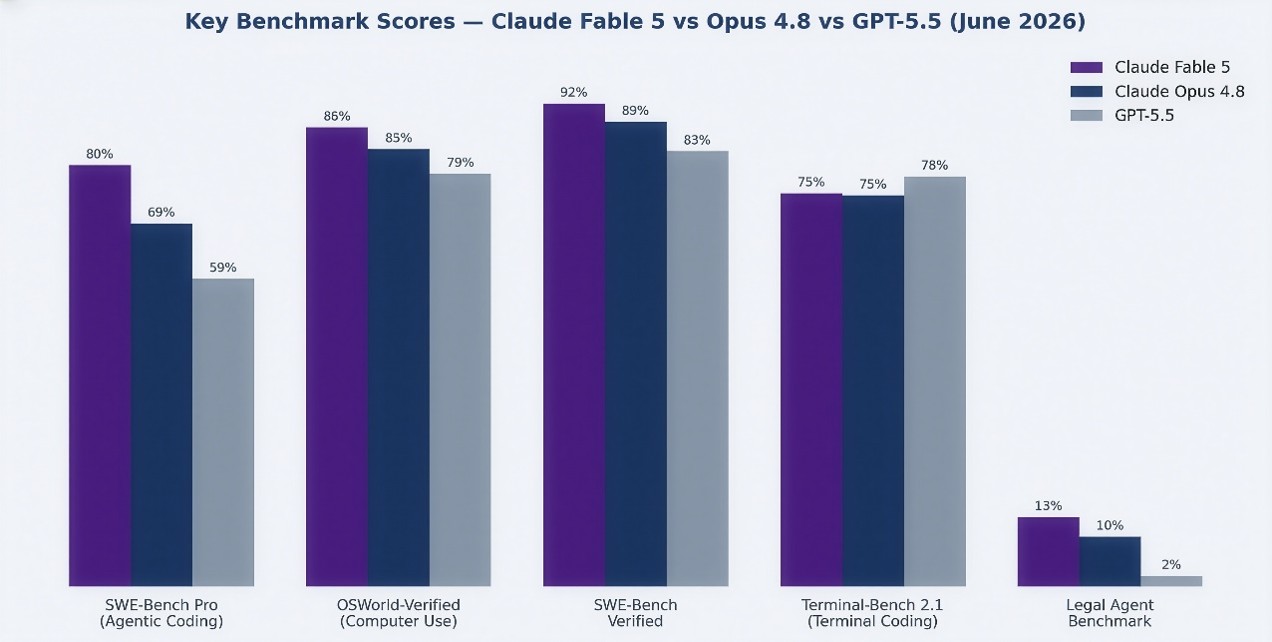
Figure 3: Benchmark comparison — Claude Fable 5, Claude Opus 4.8, and GPT-5.5 (June 2026). Scores sourced from Anthropic's official launch documentation.
4. Claude.ai — Consumer and Professional Interface
Claude.ai is Anthropic's flagship chat product, available as a web application, iOS/Android mobile app, and desktop client. It is the most accessible entry point for individual users and knowledge workers. Subscription plans include Free, Pro ($20/month), Max ($100/month), and Team and Enterprise tiers.
4.1 Core Chat, Files, and Web Search
Claude.ai supports open-ended multi-turn dialogue, document uploads (PDFs, Word files, spreadsheets, images), and optional web search for real-time information. A Deep Research mode enables Claude to conduct multi-step, web-assisted investigations, returning a comprehensive cited report on a given topic. Voice mode has also been available in beta on mobile since late 2025.
4.2 Artifacts, Code Execution, and App Building
The Artifacts system renders self-contained outputs — React components, HTML pages, SVG diagrams, data visualisations, and Markdown documents — as interactive previews inside the conversation. Combined with a full container environment for code execution (available since September 2025), users can install packages, clone GitHub repositories, and run code directly in Claude.ai without leaving the interface. In early 2026, Claude gained the ability to build, host, and share interactive web apps from within the chat — significantly expanding what a non-technical user can create and deploy in a single session.
4.3 Memory, Projects, and Personalisation
An optional memory system retains user preferences, professional context, and recurring topics across sessions. Projects allow users to organise conversations and share large quantities of reference material with Claude — with support expanded in 2026 to accommodate ten times more content per project than previously. Users retain full control over all stored memories and can delete them at any time.
4.4 Effort Controls
With the Opus 4.8 release, Claude.ai gained user-facing effort controls that let subscribers choose how much computational work Claude applies to a response. Lower effort produces faster, more concise replies; higher effort settings (xhigh, max) apply more reasoning and produce richer outputs, at the cost of greater token consumption. This shift towards token-based usage is part of a broader move away from fixed-feature subscription tiers.
5. Claude Code — Agentic Software Development
Claude Code launched as a limited research preview in February 2025 and has since become one of Anthropic's most commercially significant products, growing to a billion-dollar run rate within six months. It is a command-line tool that turns Claude into an autonomous coding agent capable of reading, editing, and executing code within a developer's actual project environment, not just generating snippets in a chat window.
5.1 Core Capabilities
Developers install Claude Code via npm and invoke it from a terminal inside their project directory. It can read entire codebases, modify files, run tests, execute shell commands, and carry out multi-step implementations with minimal human intervention. It integrates with VS Code, JetBrains, and is also available as a browser-based tool on Claude.ai. Claude Code was included in the Pro plan in early 2026, and admin controls for business plans were added for Team and Enterprise customers.
5.2 Dynamic Workflows — Parallel Subagents at Scale
The most significant Claude Code feature introduced alongside Opus 4.8 is Dynamic Workflows, currently in research preview for Enterprise, Team, and Max plan holders. It allows a single Claude Code session to spawn up to 1,000 parallel subagents, each with its own context window, orchestrated by a JavaScript runtime that Claude writes itself. This enables codebase-scale migrations and transformations across hundreds of thousands of lines of code. Stripe's reported use of Fable 5 in Claude Code — completing a two-month migration in a single day — exemplifies the ambition of this capability.
5.3 MCP Integration and Remote Tool Access
Claude Code supports the Model Context Protocol (MCP), allowing it to connect to databases, CI/CD pipelines, internal APIs, browsers, and other services through a standardised interface. Remote MCP server support was added in early 2026, extending the range of services Claude Code can reach beyond local development environments. Enterprise-managed MCP connector access, starting with Okta integration, was introduced in June 2026, allowing administrators to provision connector access organisation-wide through their identity provider.
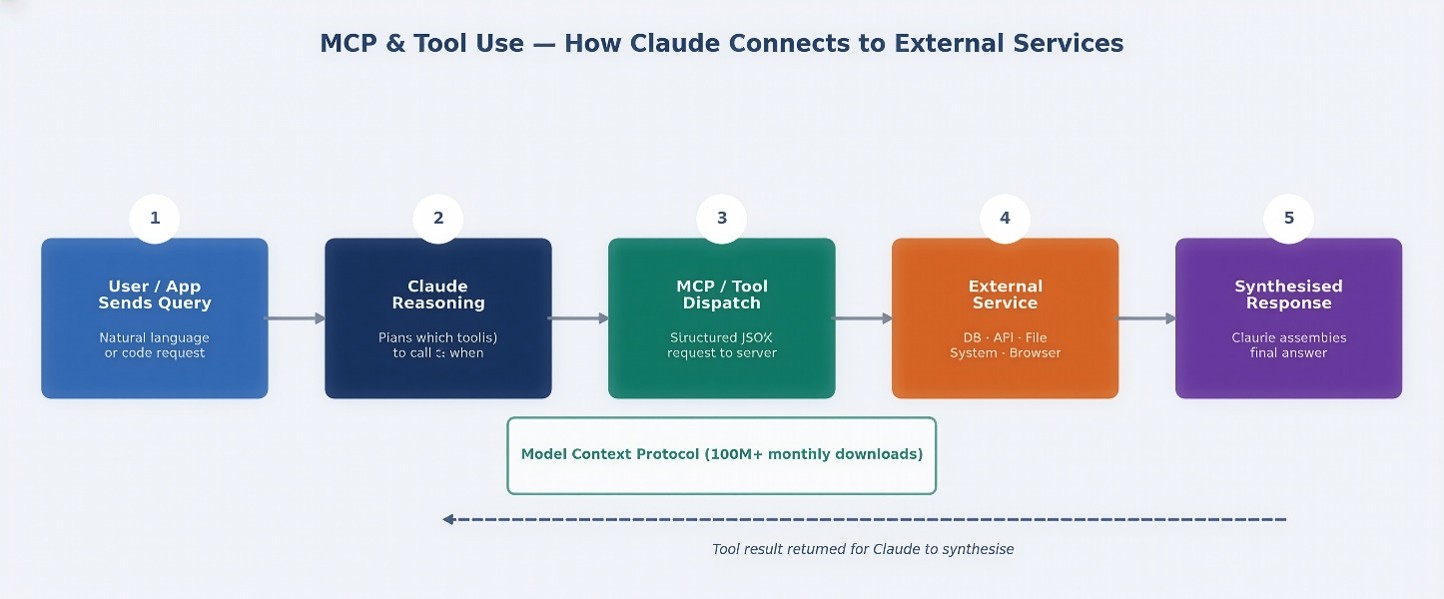
Figure 4: The MCP and Tool Use architecture — how Claude dispatches structured requests to external services and synthesises the results.
6. The Claude API and Developer Platform
The Claude API is available on the Claude Platform and through cloud marketplaces: Amazon Bedrock, Google Vertex AI, and Microsoft Foundry. It exposes all Claude model tiers via standard REST endpoints, with official SDKs for Python and TypeScript. Streaming is supported throughout.
6.1 Tool Use, Batch Processing, and Prompt Caching
The core API feature set includes tool use (function calling), enabling Claude to invoke developer-defined functions as part of its reasoning process. This is the foundation for building production agentic pipelines. The Batch API supports large-scale offline workloads at reduced cost. Prompt caching — which allows frequently reused portions of a prompt to be cached for lower-latency and lower-cost repeat requests — now supports prompts as short as 1,024 tokens with Opus 4.8, down from higher minimums on earlier models.
6.2 Managed Agents and Self-Hosted Sandboxes
Claude Managed Agents, introduced in 2026, allow developers to deploy Claude agents that run on a schedule (via cron), securely access CLI tools and authenticated services, and operate within developer-controlled sandboxes. The agent loop runs on Anthropic's infrastructure, while tool execution can be moved to the developer's own environment — via Cloudflare, Daytona, Modal, Vercel, or custom infrastructure. This design keeps sensitive files and proprietary codebases within the operator's security perimeter while still leveraging Claude's reasoning. MCP Tunnels, in research preview, allow private MCP servers to be reached securely from Anthropic's infrastructure.
6.3 The Model Context Protocol
MCP is an open standard, created by Anthropic, that gives AI systems a universal interface for connecting to external data sources and tools — replacing hundreds of bespoke integrations with a single protocol. Since its open-source release, MCP has reached over 100 million monthly downloads and has been adopted as an industry standard by tool developers, enterprises, and cloud providers. Pre-built MCP servers are available for Google Drive, Slack, GitHub, Postgres, and many other platforms, and the Anthropic Labs team continues to expand the connector ecosystem.
7. Claude Design, Productivity Tools, and Anthropic Labs
Beyond core chat and coding, Anthropic operates a Labs team focused on experimental products at the frontier of Claude's capabilities. Several have reached commercial availability.
7.1 Claude Design
Claude Design, available at claude.ai/design and in the sidebar of the Claude desktop app, is a design and prototyping tool that attracted over one million users in its first week. It can import design systems from GitHub repositories, design files, or raw uploads, build with a team's own components, and check its output against the design system before presenting it to the user. It works fluidly with Claude Code, allowing a handoff from visual design to implementation within the same workflow. In June 2026, Claude Design gained the ability for users to edit directly on the canvas and to connect to a broader range of external design tools.
7.2 Office and Productivity Integrations
Anthropic offers Claude integrations for Microsoft Excel, PowerPoint, Word, and Outlook — allowing Claude to analyse spreadsheet data, draft presentations, edit documents, and triage inboxes from within the user's existing Office environment. Claude in Chrome is a browser-based agent that can navigate websites, fill forms, and complete multi-step browsing tasks on the user's behalf. Cowork, a desktop tool for non-developers, enables users to automate file management and repetitive task workflows in natural language, with effort controls available following the Opus 4.8 release.
7.3 Project Glasswing and Restricted Access Tools
Project Glasswing is Anthropic's trusted-access programme for cybersecurity applications of its most powerful models. Originally launched with Claude Mythos Preview in April 2026 to a small set of infrastructure providers and government partners, it has since expanded to approximately 150 organisations across more than fifteen countries. Participants use Mythos-class models to identify and patch software vulnerabilities at a scale and speed not previously achievable — including the discovery of a sixteen-year-old vulnerability in FFmpeg and previously unknown kernel-level privilege escalation vectors in Linux. Claude Mythos 5, launched 9 June 2026, is an upgrade to Mythos Preview within this programme.
8. Safety, Alignment, and Responsible Deployment
Safety is Anthropic's stated founding purpose and an active engineering priority across all products. Claude models are trained using Constitutional AI — a technique in which the model evaluates and improves its own outputs against a set of principles — combined with reinforcement learning from human feedback (RLHF). Opus 4.8 showed improvements in alignment measures including lower rates of deception and reduced susceptibility to misuse attempts compared to its predecessor, with deception rates approaching those of the restricted Mythos Preview model.
For operators building on the Claude API, a layered permission system allows deployment-specific customisation of Claude's behaviour within the bounds of Anthropic's usage policies — enabling, for example, a children's education platform and a financial research firm to configure appropriately different constraint levels. The Fable 5 launch introduced safety classifiers that automatically route high-risk cybersecurity and biology queries to Opus 4.8, a design that Anthropic has described as allowing Mythos-class capability to reach general users without the attendant misuse risks. The Anthropic Institute, launched in March 2026, is a new research effort dedicated to studying the societal impacts of powerful AI and shaping policy and governance frameworks.
9. Conclusion
Anthropic's commercial AI portfolio has matured rapidly. In the space of a year, the company has shipped multiple flagship model upgrades (Opus 4.5 through 4.8), introduced an entirely new model tier (Mythos class / Fable 5), launched a billion-dollar developer tool (Claude Code), established an industry-standard connectivity protocol (MCP), and extended Claude into design, office productivity, and browser automation. The cadence of releases — Opus 4.7 to 4.8 in just 41 days — signals both competitive pressure and growing technical confidence.
The common thread across all of Anthropic's products is an emphasis on long-horizon, autonomous work: models that can sustain complex tasks over extended periods, tools that can orchestrate thousands of parallel subagents, and infrastructure that keeps enterprise data within secure perimeters while still leveraging frontier AI reasoning. As the company moves toward a public market debut, the Claude ecosystem it has built positions it as one of the most complete and commercially credible AI platforms available in 2026.
Placement Status January ‘26-May ‘26 – IT Scholarship Programme
The placement of the IsDB-BISEW IT Scholarship Programme graduates in jobs is the ultimate goal of the training programme. Successful placement performance is an enduring feature of the IT Scholarship Programme. A summary of the programme's placement performance for the period 1 January 2026 to 31 May 2026 is provided here, with course-wise breakdowns. :
Long Courses
|
# |
Course ID |
Course Title |
|
1 |
ACAD |
Architectural & Civil CAD |
|
2 |
CS |
Cross-Platform Apps using ASP.NET, Angular, React & MAUI |
|
3 |
DDD |
Oracle Database Application Development |
|
4 |
GAVE |
Graphics, Animation & Video Editing |
|
5 |
JEE |
Web and Mobile App Development using Spring Boot, Android & Flutter |
|
6 |
NT |
Network Solutions and System Administration |
|
7 |
WDPF |
Web Application Development with Laravel, React, Vue.js & WordPress |
Short Courses
|
# |
Course ID |
Course Name |
|
1 |
CCO |
Cloud Computing using Oracle Application Express |
|
2 |
NSA |
Network System Administration |
|
3 |
PWAD |
Web Application Development using Laravel & React |
|
4 |
WADA |
Web Application Development using ASP.NET |
|
Total Placement, Engagement & Recruiting Organizations* |
|
|
Number of graduates placed from Long Courses |
247 |
|
Number of graduates placed from Short Courses |
46 |
|
Total placed during the period |
293 |
|
|
|
|
Placed in ICT jobs |
81% |
|
Placed in non-ICT jobs |
19% |
|
|
|
|
Number of graduates engaged in freelancing |
15 |
|
Number of graduates engaged in their own business |
8 |
|
|
|
|
Number of recruiting organisations |
189 |
* The figures shown above include graduates who were placed during the period Jan-May ‘26.
Graduates of Long Courses who finished their courses during the period Jan-May ‘26
|
# |
Course ID |
Placed |
|
1 |
ACAD |
38 |
|
2 |
CS |
28 |
|
3 |
DDD |
37 |
|
4 |
GAVE |
42 |
|
5 |
JEE |
23 |
|
6 |
NT |
35 |
|
7 |
WDPF |
44 |
|
Total |
247 |
|
Placed Graduates of Short Courses who finished during the period Jan-May ‘26
|
# |
Course ID |
Placed |
|
1 |
CCO |
8 |
|
3 |
NSA |
22 |
|
4 |
PWAD |
9 |
|
5 |
WADA |
7 |
|
Total |
46 |
|